The Vials Outlived the Grant: Locating the 2015 Initiative's Biobank a Decade Later
A Freezer in Massachusetts, and the Paper Trail Behind It
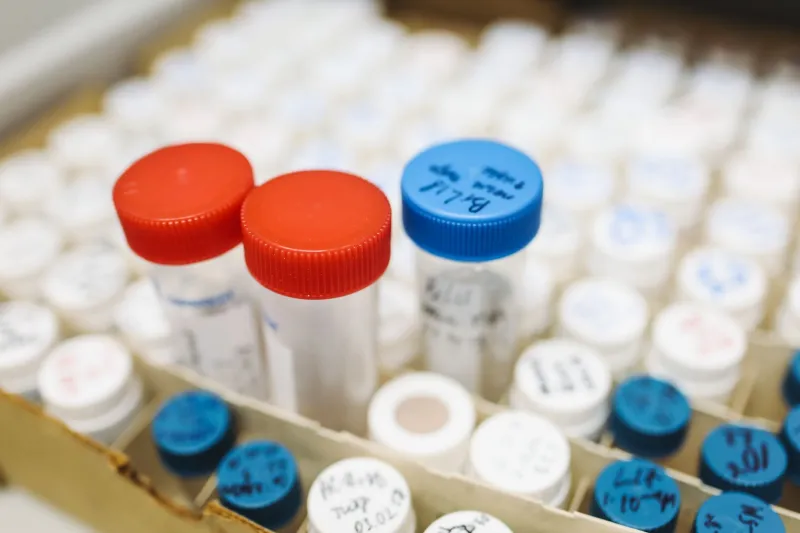
On the third sub-level of a university medical campus outside Boston, a rack of 2 mL cryovials sits in liquid nitrogen at minus 196 degrees Celsius. Each vial bears a barcode, an accession date between March and November 2015, and a study code that points—through a chain of data-use agreements—to the Human Reproduction Research Initiative, the consortium whose proceedings this archive documents.
The specimens are not unusual in origin. What is unusual is that they still exist, in usable form, ten years after the grant that funded their collection expired. Many comparable collections did not survive the decade.
What 2015 Consent Language Actually Promised
The consent forms of the era were drafted in a transitional moment. The revised Common Rule had not yet taken effect; institutional review boards operated under the 1991 regulations, and broad consent—now routine at American academic centers—was still contested territory.
Reviewing a sample of de-identified consent documents from four of the initiative's participating sites reveals three distinct approaches. One site obtained consent limited to the named studies, with explicit destruction clauses upon study closure. Two others used language permitting "future research on reproductive and genetic conditions," a phrase broad enough to survive regulatory change but vague enough to complicate later custodial decisions. A fourth site, notably, included a recontact provision—a rarity in 2015—that has since proven decisive in whether specimens could legally be redeployed.
"The forms were written for a five-year horizon because grants are written for five-year horizons," says a repository manager who asked not to be named, citing institutional policy. "Nobody was planning for the vials to outlive the award. But they did."
Where the Collections Went
Our correspondence with curators and compliance officers at seven institutions associated with the initiative suggests the inherited collections now fall into roughly three camps.
The first is the consolidated repository. Two sites transferred their holdings to dedicated biobanks—the largest, roughly 14,000 aliquots of follicular fluid, serum, and processed tissue—under new custodial agreements that required fresh ethics review. These collections remain accessible; several have generated secondary publications on ovarian biomarkers within the past three years.
The second camp is the dormant freezer. Specimens remain in storage, technically intact, but with no active data-use agreements and no budget line for their maintenance. Custodianship in these cases has drifted to whoever holds the keys, often a lab manager whose connection to the original protocol is archival at best.
The third camp is disposal. At least two institutions destroyed remaining samples between 2019 and 2022, citing storage costs and the absence of documented participant recontact pathways. Destruction certificates exist; the scientific record, in most cases, does not note them.
Do Decade-Old Specimens Still Matter?
The scientific case for retention is genuine but uneven. Cryopreserved serum is robust; assays for anti-Müllerian hormone and inflammatory markers remain reproducible on decade-old aliquots. Processed tissue is more fragile, and nucleic acid integrity degrades variably depending on fixation and storage conditions.
Yet the more interesting question, curators argue, is not whether the material is usable but whether the metadata accompanying it is. A vial without a legible chain of custody, linked clinical phenotypes, and a defensible consent basis is scientifically near worthless regardless of its biochemical condition.
"A specimen is only as valuable as its annotation," one curator told us. "We spend more time reconstructing spreadsheets than thawing anything."
Custodial Burden as an Unstudied Cost
There is a fiscal dimension the 2015 initiative's published reports never addressed. Liquid nitrogen storage at a major US academic center runs to tens of dollars per rack per year in direct costs, with the true figure far higher once facilities overhead is counted. Multiplied across thousands of orphaned aliquots, the annual burden is real, and it falls on institutions that received no portion of the original award.
Some repositories have begun charging internal rent—a mechanism that quietly accelerates disposal decisions when no investigator claims a collection. Others have adopted scheduled review cycles, flagging specimens for destruction unless a researcher affirmatively asserts interest within a set window.
A Caution for the Current Decade
The 2015 biobank's fragmented afterlife is not a story of negligence. It is a story of what happens when a field's ambitions for longitudinal, specimen-backed science outrun its infrastructure for stewardship. The consent forms were adequate for their moment; the custodial planning was not.
For investigators designing biobanking components today, the lesson from this archive's decade of hindsight is straightforward: plan for the vials, not the grant. The vials will last longer.