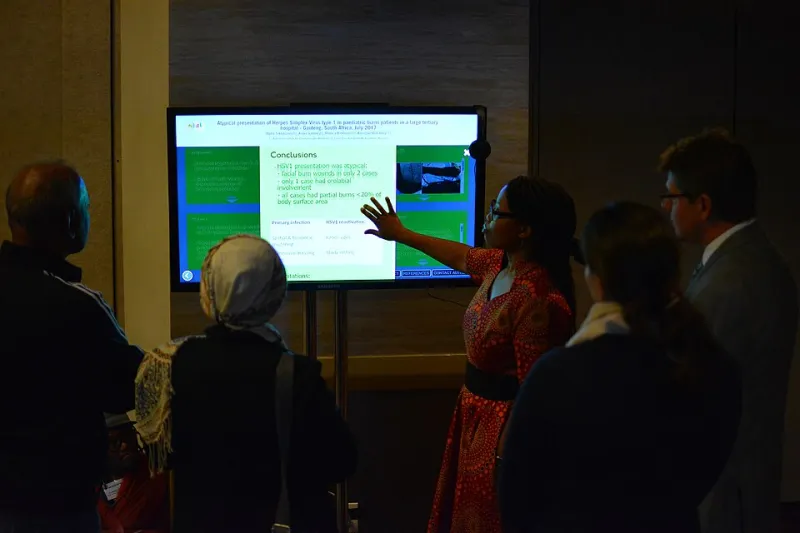
Lexicon of the Plenary Hall: Tracing the Clinical Vocabulary Born in 2015

The Words Arrived Before the Consensus Did
Archives are usually consulted for data. The HumanRep 2015 Archive suggests they should also be consulted for diction. A systematic reading of the initiative's abstract volumes, plenary slide decks, and the handful of patient-facing handouts distributed at the registration desk reveals that several terms now considered standard clinical vocabulary entered circulation through this conference—not through guideline committees, which formalized them only years later.
The pattern is consistent across the corpus. When "ovarian reserve" appears in 2015 materials, it is frequently hedged, italicized, or introduced with qualifiers such as the now-archaic "so-called." By the 2017 ASRM committee opinion cycle, the same phrase appears without comment. Similarly, "embryo competency"—a phrase that appears in only four abstracts in 2015, three of them from a single Pittsburgh-affiliated group—had become unmarked, uncontroversial terminology in US clinical literature by decade's end.
From Podium Phrasing to Chart Entry
The transmission mechanism matters as much as the origin. Reviewing the archived slide decks alongside the initiative's correspondence files shows that terminology spread through three channels: plenary talks that were widely summarized in trade coverage, a pre-conference symposium for reproductive endocrinology fellows, and—less formally—the exhibit hall conversations captured in attendee letters now held in the archive.
Notably, patient-facing language lagged by roughly two years. The 2015 handouts refer to "egg quantity testing" where the scientific sessions used "ovarian reserve assessment." Current CDC patient materials have largely collapsed that distinction, adopting the technical term directly. This convergence, documented in a side-by-side comparison of archived handouts against contemporary patient education literature, marks one of the quietest but most consequential shifts of the decade: patients now receive the same vocabulary clinicians use among themselves.
Glossary: 2015 Usage Mapped to Current Guidelines
The following reference table, compiled from the archive's abstract volumes and cross-checked against current professional society guidance, is offered as a working tool for investigators preparing historical or systematic reviews.
Ovarian reserve — In 2015 abstracts, often qualified as "diminished ovarian reserve (DOR)" with inconsistent diagnostic thresholds. Current practice aligns threshold definitions with AMH- and AFC-based criteria standardized in post-2016 committee opinions.
Embryo competency — 2015 usage ranged from morphological grading to speculative morphokinetic claims. Contemporary guidelines restrict the term to euploidy-verified assessments; archived slides using the term for morphology alone now read as overreach.
Reproductive aging — Appeared in 2015 predominantly in population-science abstracts. Now standard in counseling contexts, a migration from research lexicon to clinical conversation documented in the archive's patient-handout holdings.
Elective single embryo transfer (eSET) — Already established in 2015 but with variable abbreviation use. The archive shows the abbreviation consolidating within eighteen months of the initiative, driven partly by plenary repetition.
Fertility preservation — In 2015 materials, applied almost exclusively to oncology contexts. Current usage extends to elective oocyte cryopreservation, an expansion the 2015 corpus anticipates in only a single poster abstract.
Why Linguistic Provenance Matters
For researchers, the value of this exercise is methodological. Systematic reviews that treat terminology as timeless risk misclassifying older studies—coding a 2015 abstract's "embryo competency" finding as equivalent to a 2020 euploidy-based result when the underlying constructs differ. Precise dating of when terms entered, shifted, or narrowed is therefore not an antiquarian pursuit but a requirement for accurate evidence synthesis.
The archive's holdings also caution against tidy narratives. Not every 2015 coinage survived. "Oocyte developmental potential," a phrase appearing across seven abstracts, has effectively vanished from US literature, displaced by more specific constructs. Vocabulary, like data, is subject to selection pressure—and the record of which words lived is as instructive as the record of which findings did.