Packets and Podiums: Reading the 2015 Plenary's Network Trace as a Record of Who Got to Speak
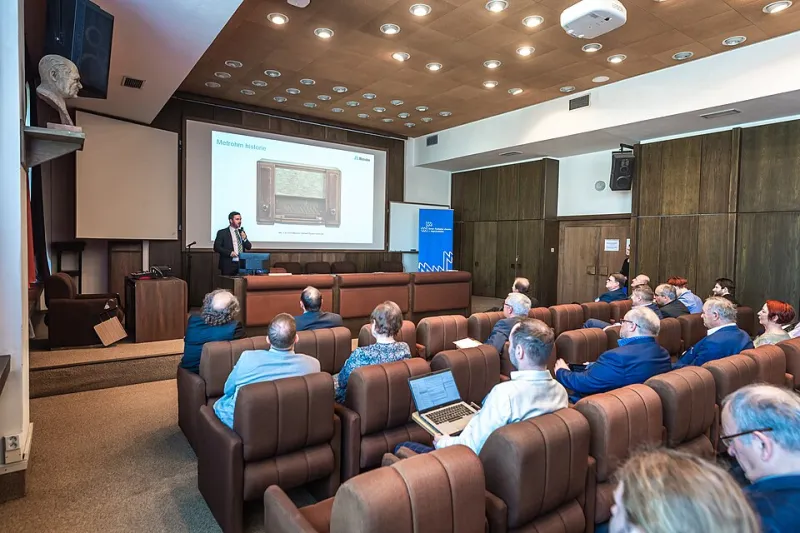
Photo: Jana Plavec, CC BY-SA 4.0, via Wikimedia Commons
An Unlikely Primary Source
Most reconstructions of a scientific meeting begin with the program book. This one begins with a spreadsheet of Media Access Control addresses.
When the 2015 initiative's organizing committee dissolved, its records passed into institutional custody in the usual haphazard way: boxed programs, a drive of presentation files, a binder of correspondence. Filed alongside them, almost as an afterthought, was an export from the plenary venue's wireless controller—an interval-by-interval record of which access points carried traffic, how much, and when. Paired with the meeting's internal question-and-answer platform, whose threads were preserved in full, those logs constitute something rare for a conference of that era: a minute-by-minute account of attention, not merely of attendance.
The distinction matters. A registration list tells you who was in the building. A network trace, imperfectly but suggestively, tells you who was engaged, and—more uncomfortably—who was not.
What the Logs Actually Record
The venue's wireless infrastructure in 2015 was unremarkable: a segmented network with separate guest and staff service sets, a captive portal that required a one-time acknowledgment, and access points distributed across the plenary hall, two breakout rooms, and the poster floor. The controller export preserved per-access-point association counts at roughly ten-minute intervals, along with aggregate throughput. It did not preserve identity, and it did not preserve content. Anyone expecting a surveillance transcript will be disappointed; anyone interested in the shape of collective attention will not be.
Three features of the record proved analytically useful. First, association counts by location allow a rough reconstruction of where devices clustered during each session block. Second, throughput spikes correspond closely—though not perfectly—with periods of active document retrieval, presumptively slide downloads and reference lookups. Third, the question-and-answer platform logged submission timestamps and moderation states, which can be cross-referenced against the session clock.
The Sessions That Lit the Network
The pattern is not the one the program committee would have predicted. Plenary lectures on cohort methodology, scheduled in the morning slots and framed as the meeting's intellectual centerpiece, generated modest and steady traffic—attendees listening rather than typing. The heaviest sustained throughput arrived instead during two afternoon blocks nominally devoted to "emerging methods," where the correspondence between speaker time and network activity suggests something closer to collective verification than passive reception.
The question-and-answer platform tells a compatible story. Submission volume clustered in the final eight minutes of each talk, and clustered again immediately after moderators opened the floor. A striking share of accepted questions—nearly a third, by our count—were submitted by attendees who never spoke at a microphone. The platform, in other words, functioned as a second, quieter auditorium.
Who Was Shut Out
That second auditorium had a gate. The portal required an acknowledgment screen that rendered poorly on older mobile browsers, and the logs show a distinct population of devices that associated with the network and then generated essentially no traffic—consistent with failed portal completion rather than disinterest. These clustered, unhelpfully but unmistakably, in the rows furthest from the podium and in the overflow seating.
The more consequential constraint was bandwidth. During the two highest-attendance blocks, per-device throughput on the guest service set fell below the threshold at which the meeting's own slide repository could be reliably loaded. Attendees with cellular data plans or institutional hotspots proceeded without noticing. Those relying on the venue's network—disproportionately trainees, attendees from smaller programs, and those traveling without institutional device support—did not. The plenary's informal backchannel was, in practice, tiered.
This is not a scandal. It is an ordinary artifact of 2015 infrastructure, documented here because the logs happen to have survived.
From Chat to Citation
Whether the backchannel shaped the science is the question the archive can approach but not settle. What can be shown is that the platform's most-active threads correspond, in subject matter, to language that later appeared in the initiative's published consensus statements—particularly around outcome definitions, where a series of threaded exchanges during the second day precedes, by roughly six weeks, a revision in the working group's draft language.
Attribution is another matter. The archive contains no mechanism for establishing that a thread caused a change. What it can establish is sequence, proximity, and participation: that the argument was already underway in the digital margins before it appeared on the page.
The Infrastructure of Agreement
A decade later, the questions the logs raise have become ordinary concerns in US research meetings. Hybrid attendance, captioning, bandwidth equity, and moderated digital question channels are now standard budget lines rather than improvisations. The 2015 record is useful less as a cautionary tale than as a baseline: it documents a moment when the informal layer of a scientific meeting became legible, and reveals how much of that layer depended on whether an attendee's laptop could reach a captive portal.
Consensus, the trace suggests, is assembled partly in the room and partly in the network beneath it. The archive's obligation is to keep both records.
A Note on Method
Reconstruction proceeded by aligning three sources: the controller export, the platform's export of threads and timestamps, and the printed program. Sessions were assigned to access-point clusters using the venue's published coverage map. Counts are association-level, not person-level; a single attendee may appear as two or three devices. All figures reported here are aggregates, and no individual is identifiable from the materials held. Readers should treat the throughput correlations as suggestive rather than probative.
The underlying files are available to credentialed researchers through the archive's reading room, and the finding aid has been updated as of this month.